
Thermoplastic Road Marking
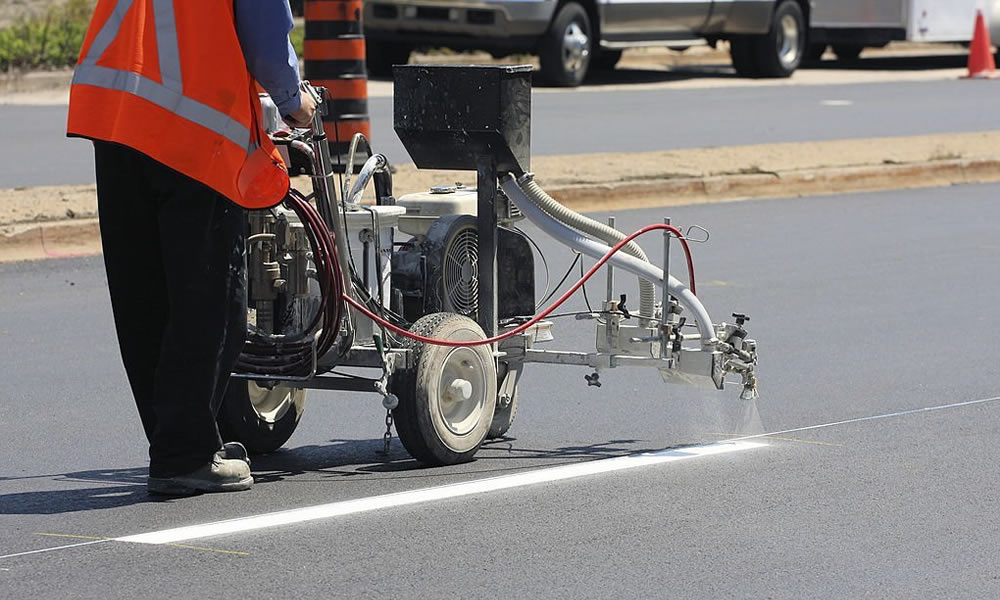
Thermoplastic road marking is one of the most important contributors to road safety. It not only provides excellent night visibility but also enforces traffic discipline and delivers necessary information to road users. For these reasons, thermoplastic road marking is used on roads across the world.
Performance Benefits
- Excellent adhesion
- High durability
- Good visibility (day & night)
- High skid resistance
- Fast drying time
- Colour brilliance
- Outstanding whiteness
- Product stability
- High softening point
- Good flow properties
- Environment friendly
Surface Preparation
The surface should be thoroughly cleaned of dust, dirt, grease, oil, and all other foreign matter. The surface must be completely dry, with no water or moisture present.
Application Method
Marking with hot thermoplastic compound is carried out using machines through screed or extrusion application processes on straight reaches, center lines, and edge markings. This ensures proper accuracy, required thickness, and uniform width of the marking.
Warranty
A warranty period of 24 months is provided, depending upon traffic volume and road conditions.
Night Reflectivity
Initial reflectivity: 200 mcds/sq.m/lx
Retained reflectivity: 80–100 mcds/sq.m/lx for up to 2 years
Expected Lifetime
1.5 to 2.5 years
Material Preparation
Thermoplastic material should be melted in a pre-heater fitted with a mechanical stirrer to achieve smooth homogeneity and to avoid overheating. The material should be heated to approximately 200°C to ensure proper melting.
Retro-Reflective Thermoplastic Road Marking Material Conforming to MoRTH Clause 803.4
Features & Recommended Use
- Retro-reflective thermoplastic road marking material with excellent whiteness.
- Conforms to Clause 803.4 of the “Specifications for Road & Bridge Works” issued by the Ministry of Road Transport & Highways (MoRTH).
- Specifically designed for tropical Indian conditions.
- Based on aliphatic chemistry, offering superior weathering resistance and long-term colour stability.
- Intermix glass beads provide long-lasting retro-reflectivity.
- Optimal balance between melt flow and flow resistance to achieve well-defined lines with desired width and thickness.
- Excellent wear resistance and strong adhesion on asphalt road surfaces.
- Suitable for application using manual methods as well as screed / extrusion automatic machines.
| Parameter | Specification |
|---|---|
| Colour | White & Golden Yellow |
| Composition | White & Golden Yellow |
| Binder | Minimum 18% |
| Glass Beads (Intermix) | Minimum 30% |
| TiO2 (for White) | Minimum 10% |
| Fillers (for White) | Maximum 42% |
| Softening Point | 102.5 ± 9.5 °C |
| Glass Bead (Intermix) | Type I – MoRTH / BS 6088A |
| Yellowness Index | Not more than 0.12 |
| Drying Time | Maximum 15 minutes |
| Daylight Luminance @ 45° |
White: Minimum 70% Yellow: Minimum 50% |
| Flow Resistance | Not more than 25% |
Direcons For Use:
- Heat the material to 180–200°C in the pre-heater with adequate agitation until the material becomes a homogeneous liquid.
- Ensure that the road surface is clean, free from dust and moisture.
- Remove any heavy deposits of paint from the road surface.
- For aged asphalt and concrete roads, apply Apcogrip as a primer coat to ensure proper bonding of the thermoplastic material with the road surface.
- Ensure that the primer is thoroughly dry and free of solvent before applying the thermoplastic material.
- Maintain the material temperature at 180–200°C and ensure adequate agitation during application.
- Do not hold the thermoplastic material above 180°C for more than 6 hours.
- Never heat the material above 220°C at any point.
- A change in colour indicates that the material has been scorched due to overheating and must be discarded.
- Drop-on glass beads must be immediately deposited after thermoplastic application.
Storage & Packing
- Storage: Minimum shelf life of 12 months when stored in a cool, dry, and covered place.
- Packing: 25 kg per pack.